Echo @ Dundee Contemporary Arts

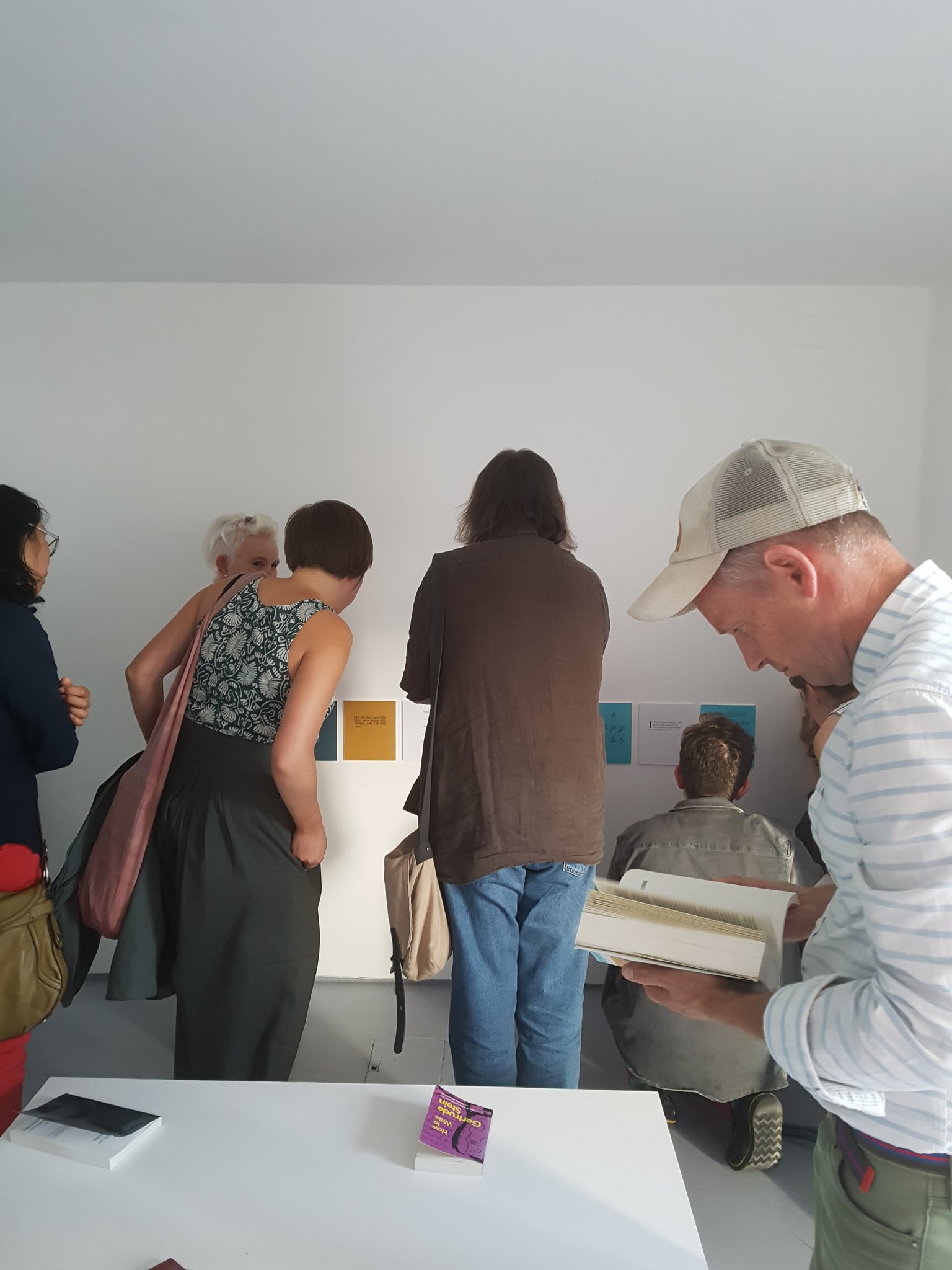
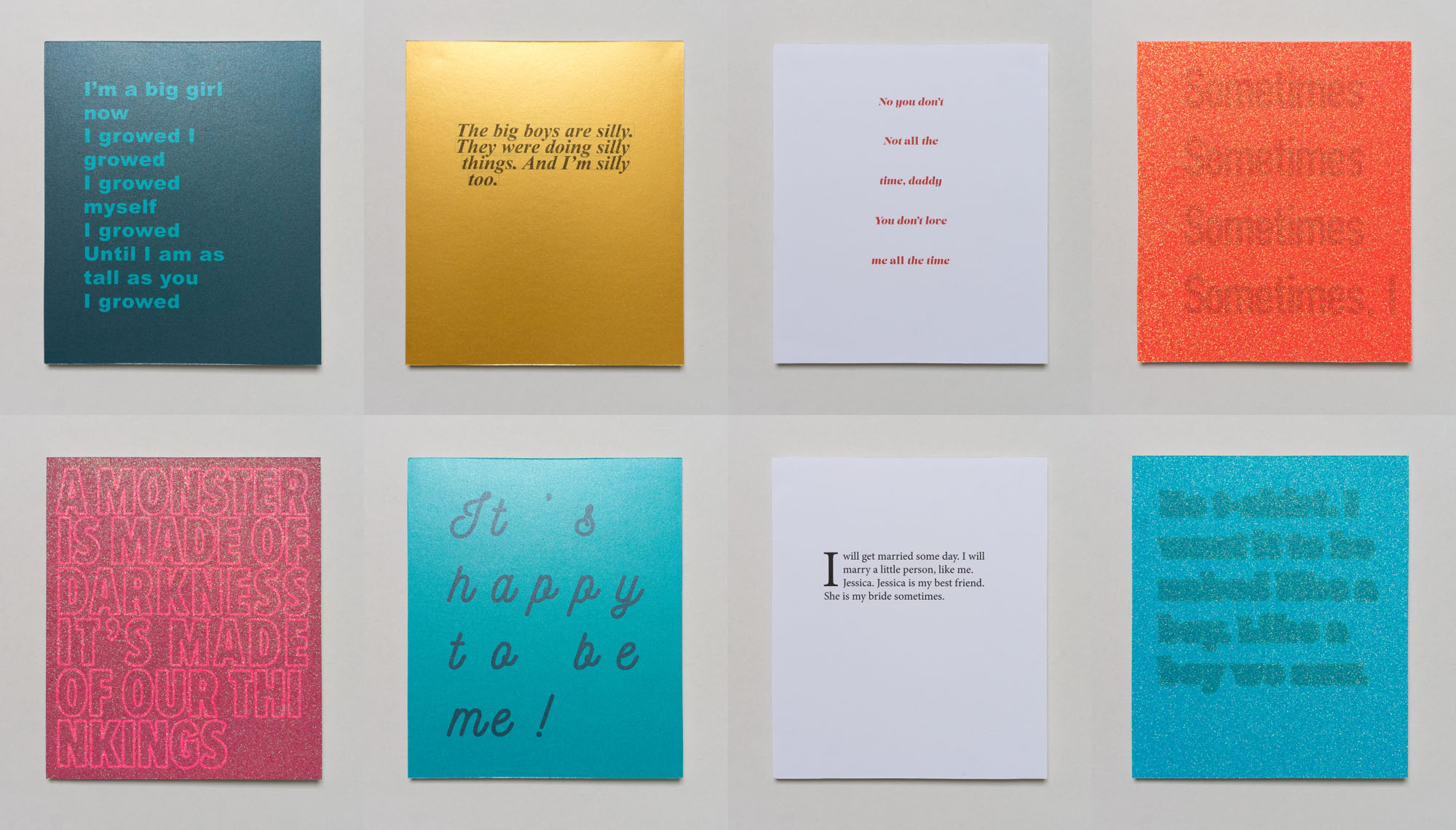
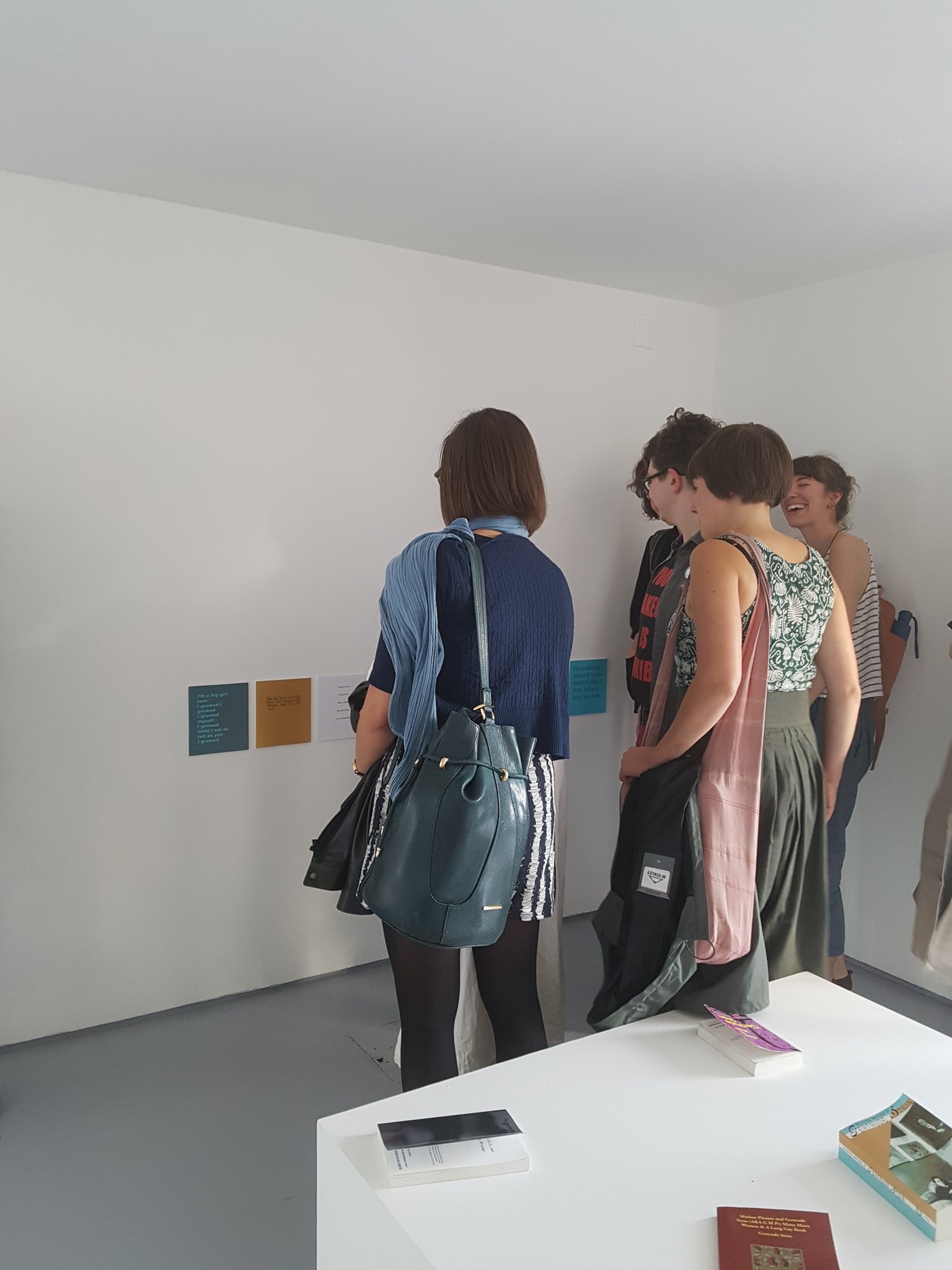
For every exhibition at Dundee Contemporary Arts, the public is invited to create its own responses to the work, in an ongoing project called Echo. Your response can take any form, and they’re exhibited, performed and so on at a special event. Recently, DCA hosted the first major European exhibition of the work of American artist Eve Fowler, and Jenny and I produced the response you see here. Below is our statement supporting it, which was read on the night.

We – a husband and wife team – wanted to reflect and further develop some of the ideas in Eve’s work, using the same vernacular in order to draw a close parallel between the original work and our response.

We both identify as feminists, something that acquired new dimensions when we had our first child, a daughter, three years ago. Watching her and listening to her talk, as she works out the world and bumps up against its limitations, and as we anticipate restrictions and opportunity throughout her life, is emotional.

In this response, we take things our daughter, Ada, says, and have Chris, her dad, transcribe and typeset them verbatim in a series of posters. The act of her voice being mediated through a literally paternalistic figure is key to the response; men have a crucial role to play in advancing the cause of feminism and equality, but in acting as the point of amplification, and even by being in control of choosing what gets amplified, we’re commenting on how deeply ingrained patriarchalism is in our society – and how even if well-meaning, it centralises power and sets tone and content.

The posters are Ada-scale and mounted at her eye level, a comment on how easy it is to overlook children and what they say, however significant. They use shiny, sparkly textures to set up a dialogue about how women’s spoken pitch and vocal fry often leads to their contributions being dismissed in cultural conversations.

The concept is Jenny’s, but after that spark of genesis her role gets deliberately sidelined; the response quotes Ada and is created by Chris. There is comment here too not just on the invisibility of women – “behind every great man…” – but also specifically on the erasing of mothers from society and its discourse.

Below are some photos of the work in situ, taken by DCA’s Helen Macdonald.
How to help when you can’t

Most people want to help when friends are struggling, but sometimes you just can’t.

Sometimes the problems your friends experience can’t be solved or even alleviated by you.

So what do you do to show up?

This is only my experience, and others may have different contexts and approaches that mean this advice doesn’t apply; I am not a mental health professional. Content warnings: Trauma, mental health crisis, suicide

Make your peace with inconsistency and uncertainty

One day your friend might be black with despair, and the next day they might show up at a social gathering apparently fine. They’re likely not fine, but this is how they’re showing up right now, for one of a dozen reasons which don’t concern anyone but them. You might want certainty and consistency from your friend so you can be there for them in the best way,  but they’re probably not gonna be able to give you that.

Their feelings and experience are always valid at every moment, even if they shift and appear inconsistent to you.

Don’t ask if they’re okay

You know the answer to that: no they’re not. It’s dumb to ask, and makes them do your emotional labour for you. If you want to know something specific (for example: “Are you considering taking your own life right now?”) then ask that if you must, but remember they don’t owe you coherence or certainty never mind answers. They might not know the answers.

(At worst, ask: “How are you right now?”)

Sit with your impotence

You want to help, and if you can’t — because they can’t tell you how or because there’s nothing practical you can do — you’re probably gonna feel pretty shitty; anxious, frustrated and impotent.

Tough. That’s your problem, don’t make it theirs.

They’re the one who is in crisis right now, and you not being able to feel good about yourself for helping them doesn’t matter.

Push, carefully

If you truly think a way you can help your friend is to ease the burden of making food, for example, then don’t ask; drop off food and text them: “There’s a couple of tubs of chilli outside your door. Ingredients are {list them}, chuck it in three days or sooner. Love you x”

If you think your friend needs to talk, say “I’ll be in the park 7–9pm if you wanna stop by and talk, but otherwise I’ll just enjoy my book!”

Don’t make them work out what they need. Assume a yes, but be happy with a thousand no’s.

Yes, it’s hard and unsettling work, and you might get it wrong a few times. Do it anyway.

“That sucks”

You wanna fix it? You might not have the skills and experience to do so. But you know what everyone can do? They can say “That sucks.”

Validate the feelings without feeling like you have to deal with them — which protects
your peace too.

They might be a dick — right now

When someone’s hurting, confused, disenfranchised or hopeless, they might lash out, pushing you away tacitly or deliberately. They might not realise they’re doing it, or they might have fucked-up or valid reasons for doing so.

You’re gonna have to absorb some of this.

How much you do depends on a few factors — how many spoons you have yourself, how close a friend they are, and whether they have a proven track record of ‘not being a dick’ before this crisis, and thus deserving of your porosity.

You’re not obligated to absorb infinite emotional punches, but good friends deserve you not tapping out when the first one lands. Get up. Fight for them, not with them.

Figure out what kind of help they want and need — with mutuals’ help

Talk to mutual friends about what kind of help everyone is offering and providing, and try to work out, to synthesise between you, what is helping the most. Treat it like a work project. You might create support group chats, you might have shared notes, discuss them when you meet up.

There’s just one rule here: don’t you dare turn this into a competition. If one of you finds a way to support your friend well, you all learn and their care gets stronger, and that’s all that matters now. Nobody is ‘a better friend’; you’re getting your friend better.

To conclude…

Being around someone who’s having a bad time is often not a good time for you. If your friend is worth it, and you’re worthy of being their friend, you have to be okay with that.

And if you’ve been showing up well for your friends, yours will show up for you right now too.

This post also appears, in a shareable format, on Instagram.

Kit

I’m adding ‘Kit’ to the list of names I respond to :)

My given name is Christopher, but most people call me Chris. I have zero feelings about that, except that as a writer and producer I much prefer to be credited or bylined as ‘Christopher Phin’. That’s something of an affectation, though, since the reason is just that I think ‘Chris Phin’ typesets in a really ugly way!

I have been thinking for a few years about styling myself ‘Kit’, which is indeed an alternative diminutive of ‘Christopher’ — I like its sparkiness, I like its hard consonants, I just like its attitude, y’know? — but always vaguely thought people would Think Things about me changing my name.

Then the MP Kit Malthouse came along and was such a monumental bellend it killed the idea stone dead.

Then two things happened, basically in parallel. First, I met someone very sweet, funny, kind and smart called Kit, which acted in the background to neutralise the Malthouse stench without me really even realising it.

And then second, I was inspired by my trans friends changing their names. How dare I —  a cis-presenting white dude, who wasn’t even changing his name but just swapping to a different diminutive, and who didn’t even have to change a single scrap of paperwork — worry about what people would think, when folks switching gender have to deal with the four horsepersons of the transpocalypse: deadnaming, disgust, mockery and forms.

And so, in yet another in a long series of the advantages trans people gift even to people who aren’t trans, in their often unasked-for battle to expand our understanding of gender, today I’m just deciding, because I can:

You can call me Chris, you can call me Christopher, you can call me any time you need help… but you can also call me Kit.

I don’t know how to love him

I’ve just realised that the Lloyd Webber/Rice song I Don’t Know How to Love Him is the canonical ballad of a ‘DL straight guy’ falling in love with another man.

I’ve long thought it works well for a guy coming to terms with his bisexuality, but there was one bit that didn’t fit without reworking:

He’s a man, he’s just a man 
And I’ve had so many men before 
In very many ways 
He’s just one more

But this morning I realised it actually needs no adjustment. There’s a huge phenomenon of men having sex with other men but still identifying as straight; in short, the contention is that they’re turned on by body parts (one in particular) but not attracted to men at all, and there’s all sort of parody-worthy mental gymnastics that follow “It’s not gay if…”

I’m okay with all of that, I guess. I mean, I think they’d be happier and less likely to hurt people if they just embraced bisexuality, or another of the multi-gender-attracted identities such as omnisexual, my label, which clearly articulates that you have different kinds of attraction to people of different genders.

I do, though, think there’s just a lot of repression and societal pressure on men especially which stops them even thinking it’s possible never mind practical to have a loving relationship with another man, and in the case of the quoted lyrics above, we’re seeing a man who might have performed countless dozens of sexual acts with men, but who suddenly realises he’s developed emotional feelings for someone he’s been giving brojobs to. No homo. Unless…

I know this wasn’t the original intent of the song ☺️ but listen for yourself and tell me it’s not perfect!

I don’t know how to love him 
What to do, how to move him 
I’ve been changed, yes really changed 
In these past few days 
When I’ve seen myself 
I seem like someone else

I don’t know how to take this 
I don’t see why he moves me 
He’s a man, he’s just a man 
And I’ve had so many men before 
In very many ways 
He’s just one more

Should I bring him down? 
Should I scream and shout? 
Should I speak of love? 
Let my feelings out?

I never thought I’d come to this 
What’s it all about?

Don’t you think it’s rather funny? 
I should be in this position 
I’m the one who’s always been 
So calm, so cool 
No lover’s fool 
Running every show 
He scares me so

I never thought I’d come to this 
What’s it all about?

Yet, if he said he loved me 
I’d be lost, I’d be frightened 
I couldn’t cope, just couldn’t cope 
I’d turn my head, I’d back away 
I wouldn’t want to know 
He scares me so 
I want him so 
I love him so

Dash it all

In all the chatter¹ about dashes revealing the use of generative AI such as ChatGPT, I’ve seen two things missed.

First, confident assertions about em-dashes — like these — being ‘correct’ don’t make any allowance for regional variations. Em-dashes remain common in formal US styles guides, but shorter en-dashes – with spaces either side – are most usual in the UK, for example.

And it’s those pesky spaces that are the other niggle. I keep seeing people declare with absolute conviction that em-dashes shouldn’t have spaces either side, but while that is becoming common in practice — due to knowledge gaps, technical limitations and laziness — the established convention had been to use hairline spaces.

× With em-dashes — like these — full spaces are wrong²
× With em-dashes—like these—no spaces is also wrong² (and ugly)
✓ With em-dashes — like these — hairline spaces are right³

How do you type hairline spaces? That’s the problem: you can’t, easily. I have a macro set up which syncs to all my devices so that when I type ‘//em’, I get a hairline space (Unicode glyph U+200A), then an em-dash, then another hairline space.

And you know damned well AI didn’t write this because even it can’t be this boring.

¹ In short, there was an assertion that em-dashes in copy revealed that you used gen-AI to ‘write’ it, and the reason that could be true is that they’re trained on a corpus that includes the use of em-dashes, so it regurgitates that… even though normal people tend not to use them.

² For a given value of ‘wrong’; I take a very non-prescriptivist approach to language, but I find convention and the tension around it interesting.

³ For a given value of ‘right’. There are many different kinds of space characters, and different style conventions would mandate different ones. You could start here if you’d like.

If it quacks like content

I do use AI, mostly as a research aid, but I have lots of issues with it. Issues with the forced and unheeding acquisition and exploitation of others’ IP, issues with the carbon impact, and issues with inequality and inequity — even before we get to the potential disruption to creatives’ livelihoods. But I got particularly and acutely angry last night.

I saw an ad for a website building platform which now features generative AI, and in the ad we saw copy flowing magically and effortlessly into a box that promised what people would learn in the class that was being advertised.

But, you know… would they? This wasn’t the careful summary and positioning of a dedicated and passionate trainer who had developed a course to deliver key benefits to a customer, and was now laying it all out to attract them; it was spicy autocomplete guessing the what kind of things one could learn at a class like this.

Deployed well, of course, generative AI (never mind AI designed to sift insight from large amounts of data) can be a powerful and useful tool, but I worry so much that we have this tsunami of vaguely content-flavoured slop rushing towards us, and it will smash so much in its path when it makes landfall.

The General Election, 2024

This photo was shot on the day my wife and I took afternoon tea to mark the turning of a page: a month later, we’d be parents and this was our acknowledgment that this kind of life would be out of reach for a while.

By the time our daughter was born, we were already five years into a Conservative government. A party that gave us austerity, Brexit, and an aggressive language of dehumanisation for immigrants, foreigners, the poor, disabled, homeless, and queer. And so much more.

I would very much like to turn another page today. To tell a new story, a different story. A more hopeful and loving story. For my daughter, for my wife, for me, for the people I love, and for millions of people I’ve never met but who deserve the dignity and joy denied them in the climate the last 14 years of Farage-poisoned Conservative rule has created.

We can choose to bring that kind of life into our reach.

Care

Last night someone I don’t know got in touch with me, politely and humbly to ask for some advice on a professional matter. This is not uncommon, and I always make time to offer what help I can; I can’t promise I’ll actually ever help, but what I’ve got is yours as much as it’s mine.

Most every time I do this I think of Susan Kare, the quite literally iconic designer best-known for creating the icons and visual feel of the original Macintosh. When I was writing my dissertation at university, on the influence of UI design on the creative process, I emailed her to ask a couple of questions. I don’t know where she was working at the time, but she would have been busy and important, and yet, magically, she replied. Two important things for me flowed from that email. The first was small and specific, but fascinating: Kare said that when designing icons, it was less important that what they represented was immediately, intuitively obvious, and more important that, once you’d learned what that icon represented – what the link is between that little grid of pixels and the action that will result when you click it – it is a strong, unbreakable semantic association.

The second was something that has only grown in the 20-some years since I dialled up the internet and polled my POP3 server to receive that email. As I have myself got busier, and more senior, and with more calls on my attention, I more appreciate the time Kare took to reply. If ever I feel like I can’t be arsed, if ever the person getting in touch is presumptuous or even rude, if ever I feel like I should be getting paid for what is in effect some free consultancy that seems to devalue the experience and knowledge I’ve built up in my career, well, then I check myself. Dear god, if Susan Freaking Kare can take 20 minutes to read and reply to an email from a green undergrad, I can carve out some time to offer the best I can to someone who asks about what mic to buy, how to get into journalism, or wants me to sense-check their CV.

I’m still besieged by impostor syndrome, and I worry I give bad advice, but so long as I caveat what I say, then surely far better that I make time to try to help, and give someone the basic courtesy of one’s attention, rather than, embarrassed, denying folks whatever I know out of my own neurosis.

I don’t, I hope, solely do this because I want folks to think of me kindly for as long or as often as Kare’s kind act has made me think of her, though I’m not a good and self-contained enough person that that doesn’t play a part in it. But rather, I remember how shocked, delighted and excited it felt that some far-off, remote figure I contacted read and replied to my message, and I want to always honour that feeling. Absolutely fuck anyone who pulls the ladder up behind them. And thanks again, Susan.

Our Broath, Your Broath, A’body’s Broath!

My in-laws live a few miles up the east coast of Scotland, in a town called Arbroath. It tickled us no end that our daughter – surrounded by nothing but Scottish accents – parsed this as ‘our broath’.

It’s not the ‘broath’ bit that’s notable (it’s just a nonsense word in this context) but it’s interesting because the ‘our’ is a confusion that could only occur with an RP accent. In RP – and it’s always tricky to render accent phonetically without recourse to IPA, but let’s have a go – ‘our’ would be spoken a bit like ‘ah’. A Scots accent would say that like ‘ow-ur’ – adding a whole other syllable, never mind the more explicit ‘r’ sound.

So an English person may indeed hear ‘Arbroath’ as ‘our broath’ – ‘ah-broeath’ – whereas it probably would never occur to a Scot to parse it that way, because we’d say something like ‘ow-ur-broth’, with that second ‘o’ being long and flat. It’s curious, then, that Ada did hear it as ‘our broath’, and I can only assume that it comes from her watching Cbeebies, which has a lot of RP accents (though blessedly, it’s a much more eclectic mix these days).

It’s all perfectly consistent inside her head, though: the town is simply called Broath. And we know this to be true because she informed us recently that if someone was visiting where grandma and grandad live, it would just be called Broath, but to us, it’s ‘our Broath’.

A tiny, completely inconsequential thing, but something that I found fascinating, highlighting as it does the mechanisms by which we acquire language. She herself speaks with a Scottish accent, but she can hear in other accents.

Sinew, soul and cinematography

I’ve just watched Philippa Perry’s episode of Victorian Sensations, and one of the thoughts in the film resonated with me in particular.

Maybe it’s not surprising that people of the age saw so many ghosts because, in a sense, spirits did haunt the Victorian home. Every Victorian innovation – from photography to motion pictures, phonographs to fantasy books – had its own supernatural genre. Arthur Conan Doyle, creator of the hyper-rational Sherlock Holmes, drew on his real-life experience as a ghostbuster to write his ghostly fiction.

If I’m remembering correctly, this – from the programme description – is a direct quote from the script, and as the first spoken sentence concluded, I actually thought it was going to go in a different way.

Before the technological media innovations of the Victorian era – voice recording, cinematography, photography – the only way a person could be present in our world was to be present. The phonograph and cinematograph, and even photography, however, meant that a person could appear to our senses to be present even when absent, which was surely as unsettling as it was exciting. Even realistic depictions in paint or marble couldn’t summon up a sparkling, vital presence in the same way, and so might it not be arguable that this techology-led blurring between, I guess, sinew and soul – this explicit fracturing of reality – was part of what created a chink for spiritualism and metaphysics to spread into the world?

If you have only ever experienced people as living, breathing, real things, tech that made them seem to come alive or travel in space and time must have made you question and challenge your frameworks for reality.

Maybe I’m over-egging this; shamans, drugs, magicians would have been deliberately eliding the natural and supernatural for long, long before the 19th century, and maybe I’m overplaying the penetration of these technologies. Maybe too this is a well-worn trope, which I’m just ignorant of. It’s just that a possible link between the technology which allowed people to be present while actually being absent, and the rise in spiritualism, had just never before occurred to me.

Tell your story

It took me until my early thirties properly to be exposed to a really simple idea: everyone around you, indeed, everyone all over the world, has a story that brought them to today, to this minute, this second, that is as rich and internally consistent as yours.

It’s so easy to think “Oh, Derek is an asshole,” or “Jill is going to kick up such a shitstorm about this” or even just to think that the part of someone you see every day in the office or down the pub or on the pitch is the whole and total of who they are. But inside their head, there is a whole multi-faceted narrative that lead them to now, and everything they do makes sense to them – just like how everything you do makes sense to you, or at least, can be rationalised or explained or at worst excused away. See also Hannah Gadsby’s wonderful recent polemic on how good men continue to redraw the line to put the bad men on the other side, or the much more academic, though still highly readable Mistakes Were Made (But Not By Me).

This is an important lesson to internalise (and god knows I forget it so often) because it engenders empathy. Derek is not an asshole, he’s living and dealing with, oh, any number of things that are making him do assholish things. Things he might not even realise are things. Emotional literacy and self-reflection are hard.

But it took me to my late thirties to realise something else. As well as it being incumbent on me to afford others some leeway and empathy as I interact with them, recognising that their stories are more lavish and nuanced inside their heads than is apparent outside, I think we should also allow that richness to spill out of ourselves! Despite Brexit, despite Trump, despite the repugnant attacks that accompany historically marginalised groups reasserting their control over their identities and their destinies, I’m currently – today – feeling hopeful. Because around me, in the friends I have in cyber- and meatspace, and the media I chose to be exposed to, I see people much more willing to be emotionally vulnerable and honest. To allow people, in other words, to read that story inside each of us, and not to be afraid to show the world that we’re not the 2D cardboard cut-out people we usually feel we have to present as.

Much is made of social media’s tendency to let us – to tacitly encourage us – to present the best version of ourselves, and this is increasingly being called out for being unhealthy. And for sure, it basically is, although even there there is nuance; selfies, derided as vain and vacuous, can be a way of empowering people whose image was traditionally mediated through prescriptive gatekeepers, for example, and I’ve certainly shared posts on Instagram which look like the worst kind of Instagramminess, but which record and mark little personal triumphs of happiness for me.

But in my world, I’m seeing people using social media to articulate and own their issues, their problems and their insecurities – their stories. They’re prepared to show the workings-out of how you become a good and kind and whole person, rather than persisting in the fiction that they’re already complete, autonomous adults. And that’s marvellous, I think; I have become closer to friends who have embraced their chaos and their fuckups, and I believe people have been drawn closer to me when I’ve purposefully dismantled the façade I so carefully built from my teens on.

We are Pan narrans, the storytelling chimp, and telling the story of ourselves to those around us will help them understand and love us more completely. And if we listen carefully to that story as we tell it, we might just love ourselves more completely too.